Scenario Experience

Join CommunityConnect with users →
Join AskTable Community


Feishu
Choose your preferred way to join

Contact UsGet professional support →


Alibaba Cloud OffersScan for offers →

Scenario Experience
Feishu
Choose your preferred way to join
In more and more enterprises and organizations, AI is no longer just a chatbot.
People want it to help them actually get work done—check policies, read materials, analyze finances, generate reports.
But in reality, we often find:
Documents are documents, databases are databases,
AI can answer text questions but can't read tables;
can search files but can't query business data.
This is precisely the biggest gap that enterprise "AI Integrated Platform" aims to solve.
From a technical perspective, AI's two core application scenarios in enterprises are actually fragmented:
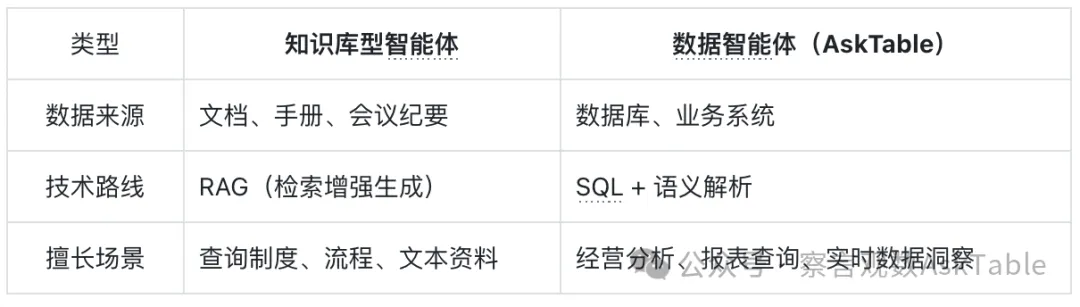
Large models themselves are very powerful, but enterprise knowledge and data often exist in layers. Only when these two parts are combined can AI truly understand the enterprise's "full picture."
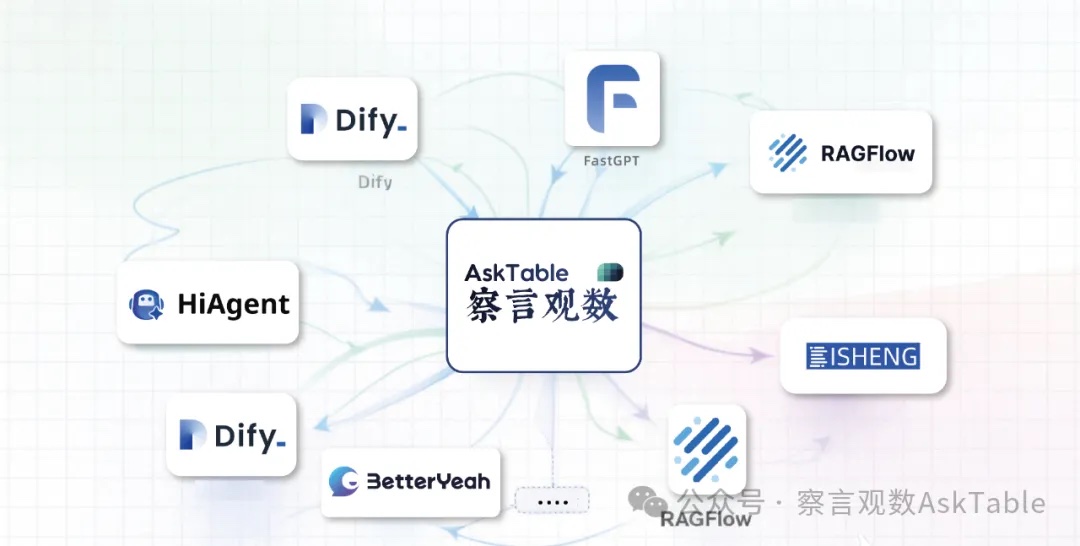
Therefore, AskTable and other AI platforms (like BetterYeah, Dify, RAGFlow, etc.) form a complementary ecosystem:
Together, they constitute a unified agent hub within the enterprise.
Inside Shaanxi Normal University, AI is deployed as a "Smart Campus Assistant," where teachers and students can directly converse within the system, for example:
Behind the scenes, this is actually completed by the collaboration of two types of agents:
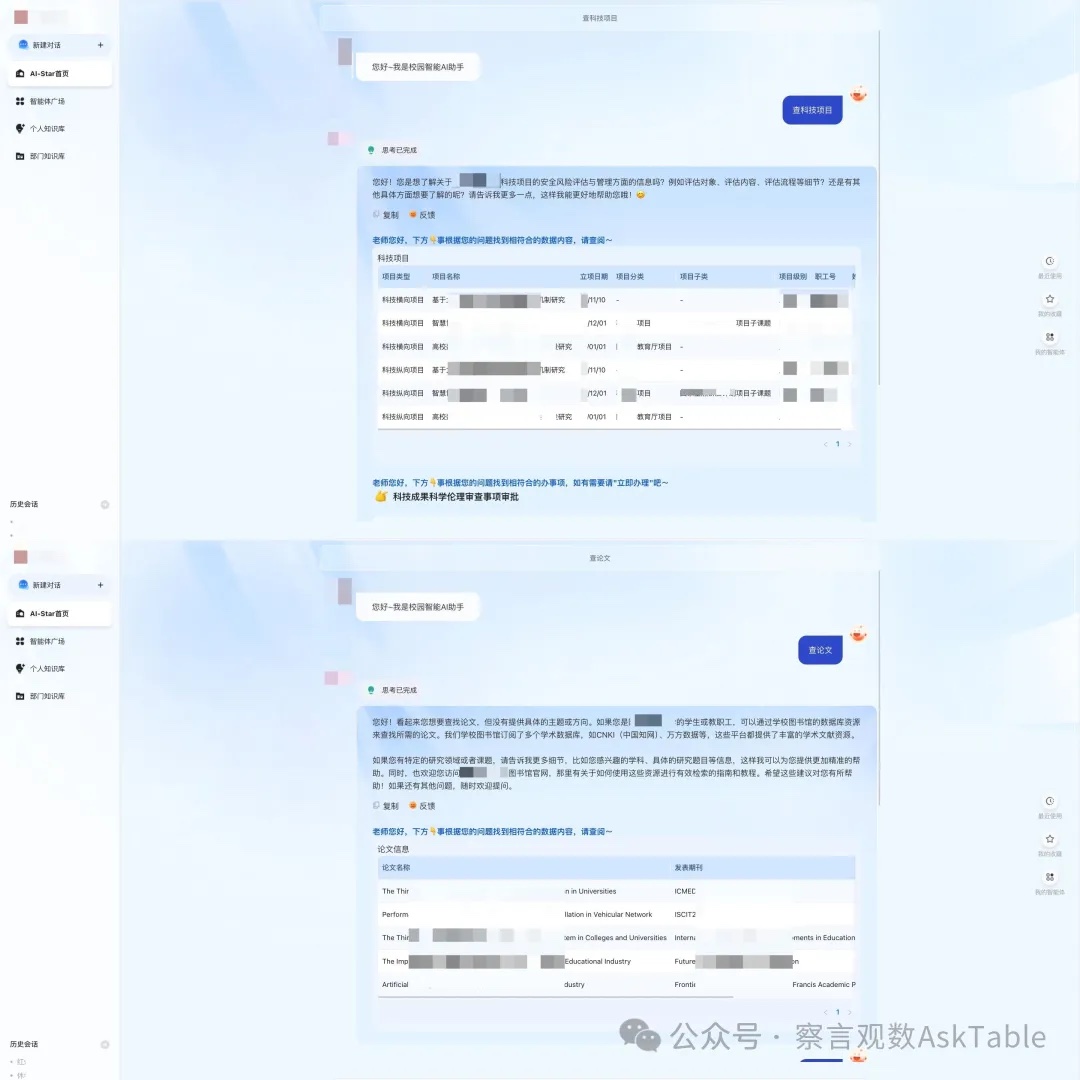
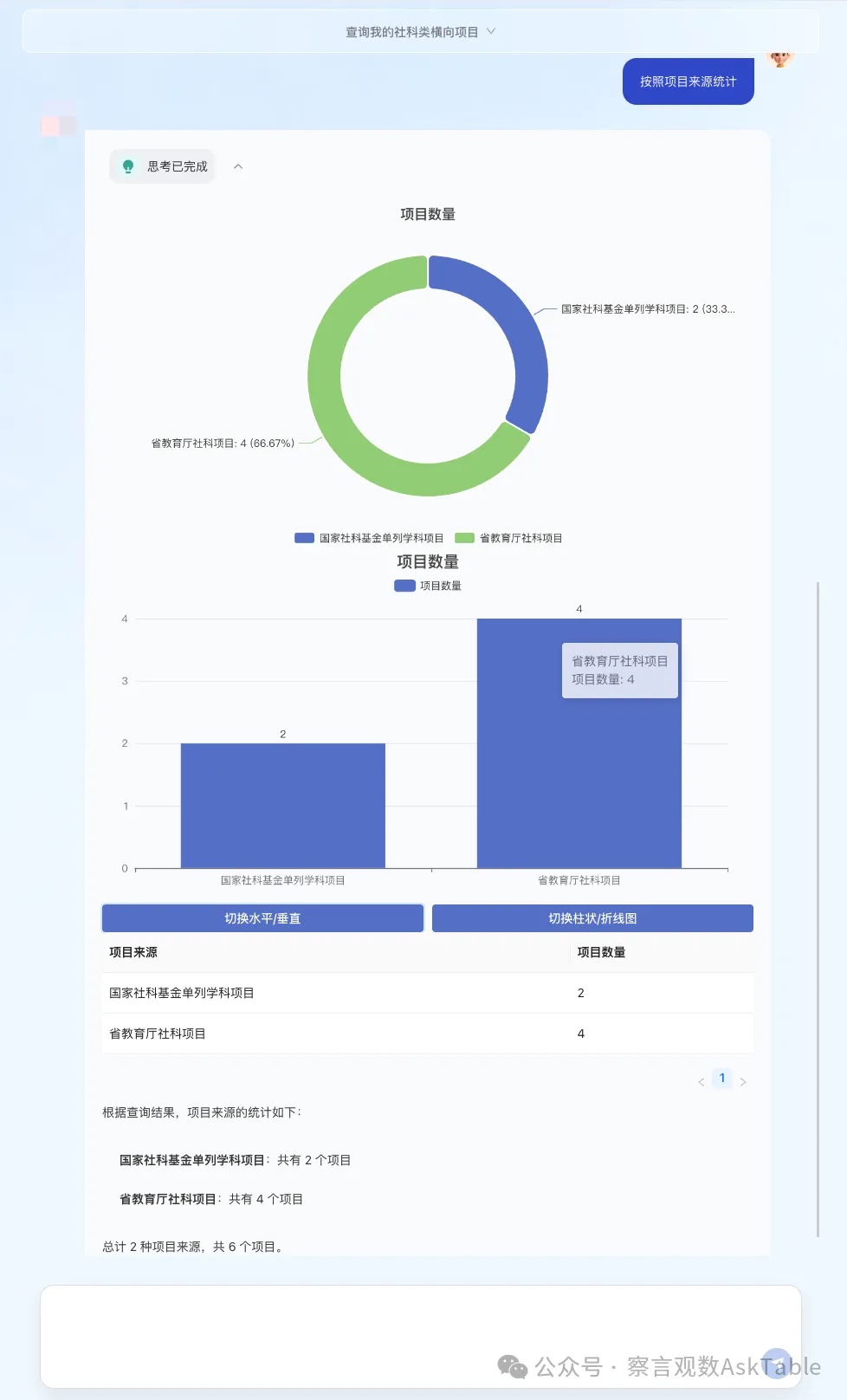
AskTable automatically returns results as tables or charts,
such as research projects by category distribution, monthly consumption trends, etc.
Operations that previously required manually exporting Excel and then analyzing can now be completed in seconds.
Teachers can immediately view research project progress,
students can also query consumption bills and research information,
everyone can directly "ask for data" without having to "find someone to get data."
Inside a central state-owned enterprise (large infrastructure enterprise), AI is integrated into the digital management system.
The platform contains multiple functional modules:

Project managers only need to ask in one sentence:
AskTable will automatically parse semantics, generate query statements, and fuse with knowledge base results, achieving natural connection from "asking knowledge" to "asking data."
In the end, business parties can obtain both document information and database results in a unified interface.
AskTable becomes the structured data brain under the knowledge base system.
The core idea of this hybrid architecture is:
"The user talks to only one agent, while multiple agents collaborate behind the scenes to complete the task."
The system logic is as follows:
AI's identity recognition and permission control for users runs through the entire process, maintaining flexible scaling while ensuring enterprise-level security and control.
Because an enterprise's "knowledge" and "data" have never been in one system.
An AI that only understands text is not enough to support decision-making;
an AI that only queries tables cannot answer questions about policies and logic.
A true agent system must integrate these two.
AskTable focuses on structured data semantic understanding and access:
It can either serve as an independent "data analysis assistant",
or serve as a "structured intelligent engine" for knowledge base platforms,
working with platforms like BetterYeah, Dify, RAGFlow to build a complete enterprise agent ecosystem.
Making AI capable of not only querying documents but also querying databases, analyzing business, generating decisions,
this is the true implementation path for enterprise intelligence.
The combination of AskTable and knowledge base platforms
is precisely the key step in moving AI from "asking knowledge" to "asking data."
No coding required. Ask questions in natural language and AI generates SQL queries and visualizations automatically.
Start your free trial now and experience AI-powered data analysis with AskTable.