AskTable
sidebar.freeTrial

Technical Analysis: AskTable's AI Architecture and Core Capabilities

AskTable Team
AskTable Team 2025-12-17

1. Product Positioning and Core Value

AskTable is a next-generation data intelligence platform driven by large models, dedicated to reshaping the interaction experience between humans and data through AI. It is no longer just a data query tool, but an intelligent agent that comprehensively combines the capabilities of analysts, developers and designers. Its core value lies in significantly lowering thresholds and empowering all enterprise personnel with data productivity.

1.1 Core Capabilities

  • AI Data Querying: Support direct questioning in natural language, AI intelligently understands data intent and automatically returns results.
  • AI-Generated SQL: Transform business language into standard, executable SQL statements, adapting to 20+ types of databases.
  • AI-Generated Reports: One-click generation of analysis reports containing tables, charts and text interpretations, suitable for business reviews and presentations.
  • AI-Assisted Data Analysis: Through innovative features like AI Canvas, support in-depth insights into complex business scenarios.

1.2 Core Concepts

AskTable is an enterprise-level AI data intelligent agent platform (AI Table Agent Platform), providing natural language-driven data analysis services. Its system architecture is designed from both user and administrator perspectives, meeting two-layer demands of "use data anytime, anywhere" and "secure and controllable."
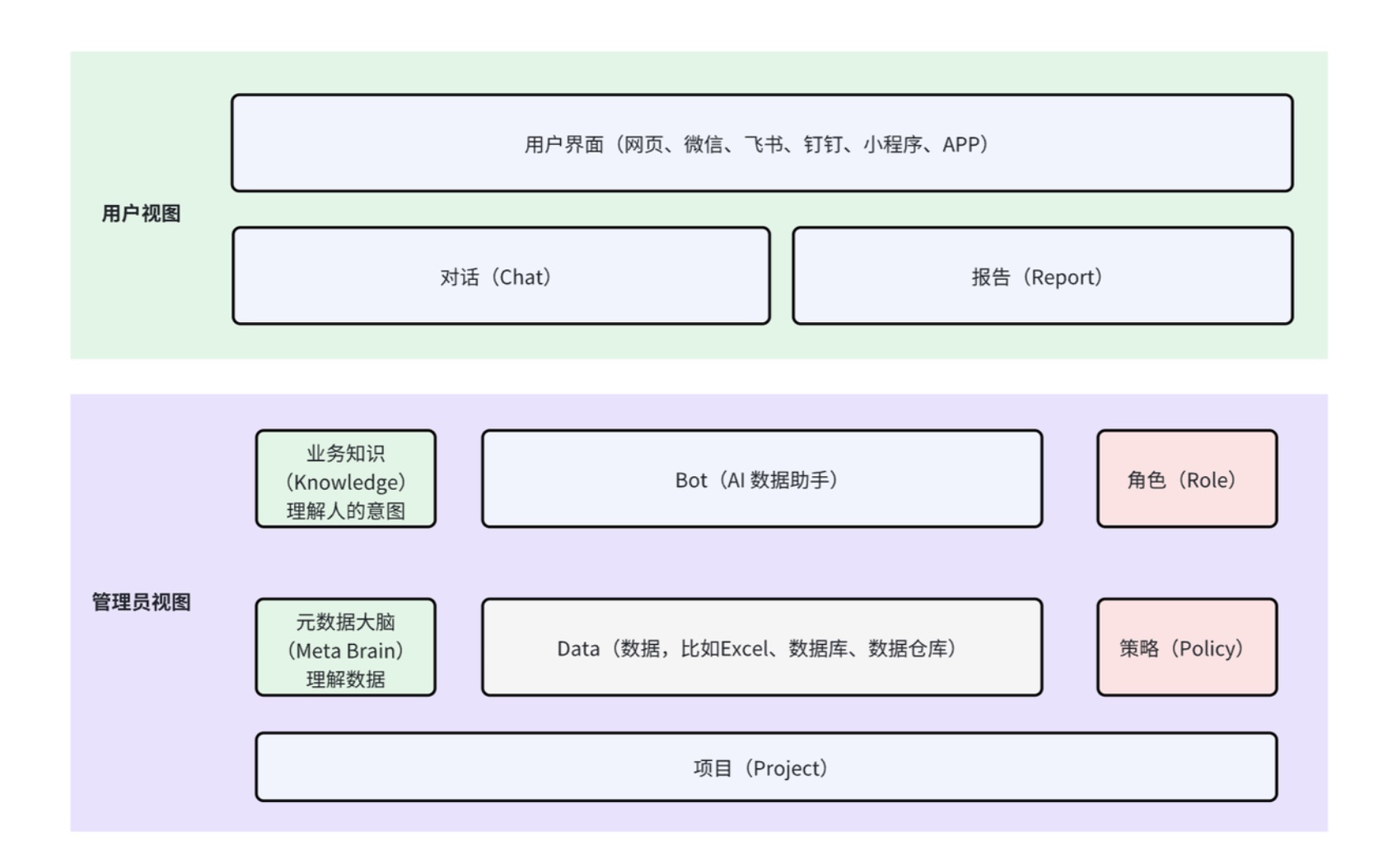
AskTable System View Structure

1.2.1 User View

For daily data users, emphasizing ease of use and efficient interaction. Supports multi-end usage such as web, WeChat, Feishu, DingTalk, mini programs, and APPs. Includes:

  • Chat: Ask questions naturally through chat interface, such as "Q3 revenue situation," system automatically generates SQL and feeds back structured results.
  • Report: Based on question results, automatically generate standardized analysis reports, integrating tables, charts and explanatory text.

No database or BI tool experience needed to smoothly complete the full chain of "question-analysis-report."

1.2.2 Administrator View

To guarantee enterprise-level needs, provides comprehensive configuration and control capabilities:

  • Knowledge: Manage enterprise terminology, rules, and context to improve Q&A business relevance.
  • Meta Brain: Unified metadata management of table structures, fields, and lineage, providing metadata foundation for automatic SQL generation.
  • Data: Connect multi-source heterogeneous data such as Excel, databases, and data warehouses.
  • Bot (AI Data Assistant): Support flexible binding of "data-knowledge-role" to customize scenario-based Q&A and analysis.
  • Role: Define permission boundaries to achieve precise authorization by department/business role.
  • Policy: Configure field-level permissions, masking, query frequency, etc., to ensure compliance and security.
  • Project: Organize resources and permissions by business line/department for easy management.

Summary: AskTable uses user view to release "ease of use" and administrator view to guarantee "controllability," achieving the best balance between efficiency and high security.


2. System Architecture and Module Composition

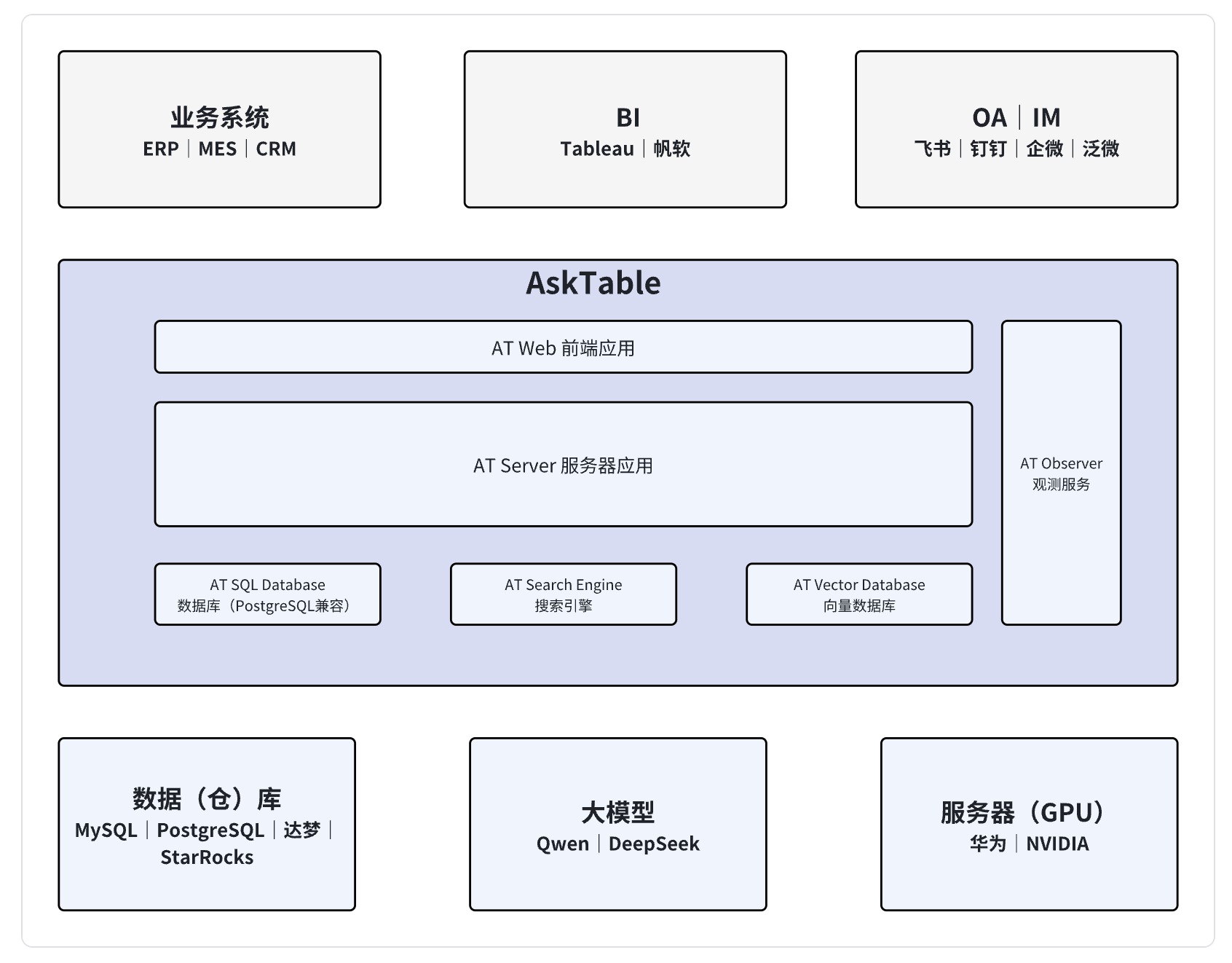
AskTable adopts modular design to ensure high availability and high scalability in complex IT environments. AskTable System View Structure
2.1 Core System Modules

  • AT Web: Frontend application, providing minimalist and intuitive interactive interface.
  • AT Server: Core server, implementing business logic orchestration and distribution.
  • AT SQL Database: Stores system metadata, compatible with PostgreSQL protocol.
  • AT Search Engine & Vector Database: Powerful search and vector database supporting retrieval-augmented generation (RAG) capabilities, ensuring precise AI retrieval.
  • AT Observer: Full-link observation service, assisting in monitoring and performance analysis.

2.2 External Integration System

  • Business System Access: Supports integration with mainstream enterprise systems such as ERP, MES, and CRM.
  • Data Source Support: Compatible with mainstream and domestic databases such as MySQL, PostgreSQL, DaMeng, and StarRocks.
  • Office Collaboration: Natively integrates with IM tools like Feishu, DingTalk, and WeChat Work, as well as BI tools like Tableau and FanRui.
  • Computing and Large Models: Supports mainstream models such as Qwen and DeepSeek, adapting to Huawei and NVIDIA GPU computing resources.

3. Architecture Interpretation: Four-Layer "Layered Architecture"

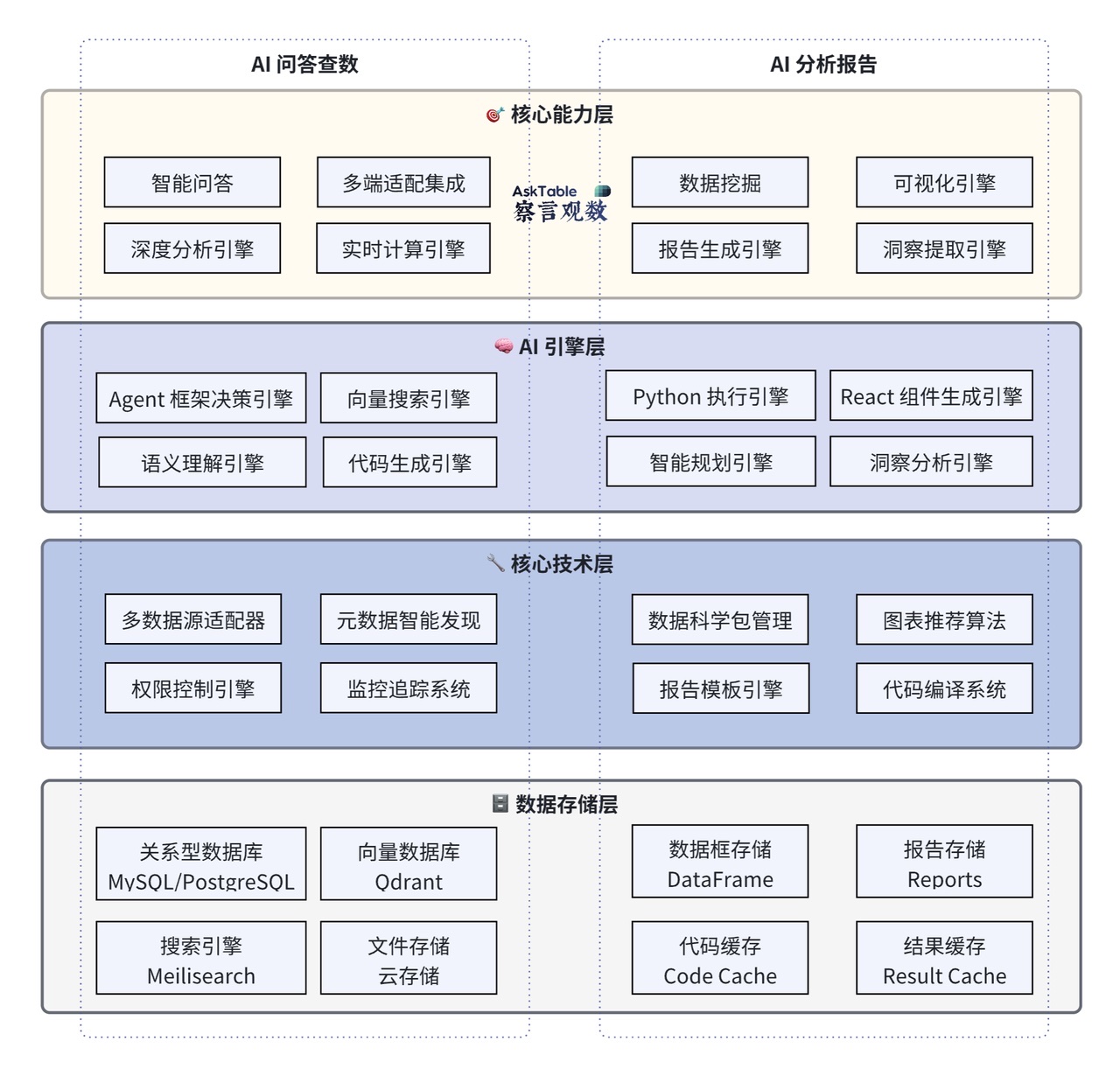
AskTable's technical system can be divided into 4 layers from top to bottom: Four-Layer Layered Architecture Diagram
3.1 Core Abilities (Capabilities Entry Layer)

面向用户,聚焦场景与体验。如智能问数、查询分析、可视化等都可一键操作。支持数据挖掘、自动报告、洞察推送,并灵活嵌入钉钉、飞书等企业生态。

3.2 AI Engines (AI Analysis Brain)

The core intelligence is responsible for automatically transforming user natural language questions into data analysis tasks. Built-in capabilities include semantic understanding, Agent decision-making, multi-step reasoning, SQL/Python generation and execution, and insight extraction. Implements the end-to-end closed loop of "understanding-planning-generating-interpreting."

3.3 Core Tech (Intelligent Infrastructure Layer)

Uses multi-data source middleware to unify database access, hiding heterogeneous underlying details. Supports metadata intelligent discovery, automatic data knowledge graph construction, refined permission management, and monitoring and tracking, supporting massive business seamless access.

3.4 Data Foundation (Data Foundation)

Efficient and reliable data and cache storage system. With MySQL/PostgreSQL as the core, combined with Qdrant vector library, Meilisearch full-text retrieval system, result cache and code cache, DataFrame/file/report persistence capabilities, ensuring data security and high-speed availability.


4. Technical Workflow: AI-Generated SQL Workflow

Understanding AskTable's work chain helps enterprises better train employees and efficiently implement data intelligence. Diagram
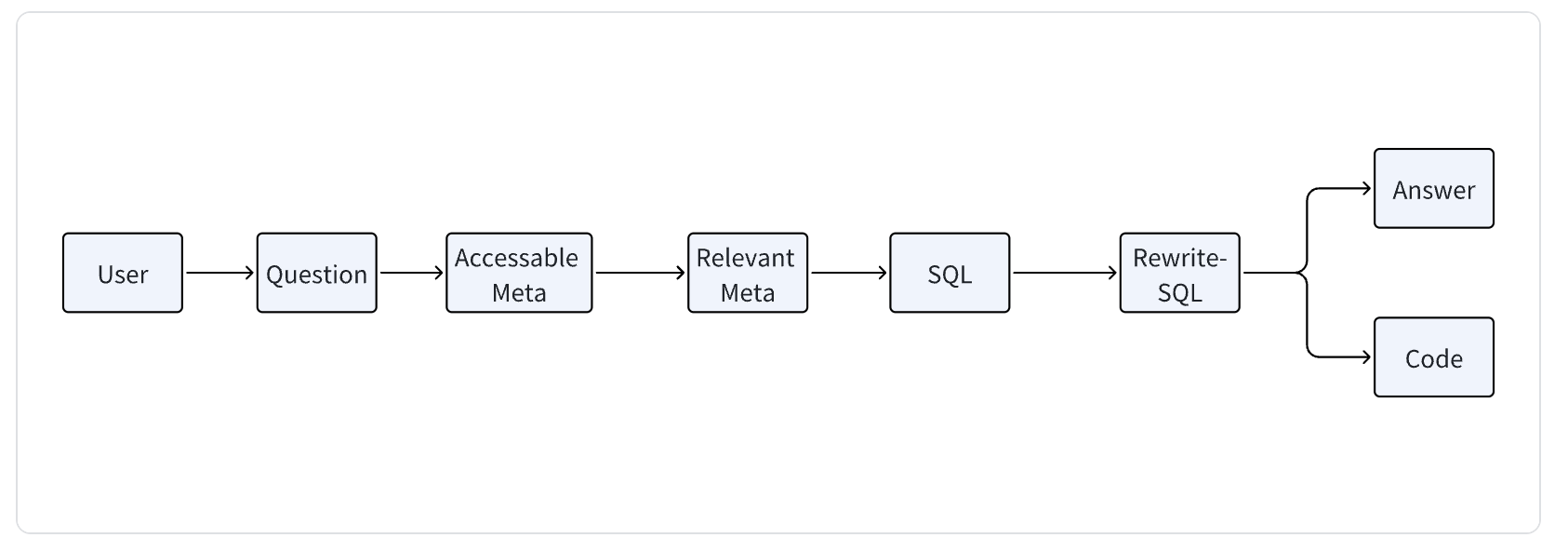
  1. User Question: Submit natural language data requirements (e.g., "Query 2024 Q1 sales").
  2. Meta Retrieval:
    • Accessible Meta: Filter available data scope based on permissions and policies;
    • Relevant Meta: Intelligently retrieve required business logic, table structure, metric explanations, and context.
  3. Generation & Rewrite:
    • AI initially generates SQL statement and automatically rewrites and optimizes queries based on personalized preferences/historical habits.
  4. Result Output: Return structured data table or executable code (Python/SQL), and automatically generate interpretation and visualization reports.

Each step is configurable and observable, supporting manual verification and adjustment, balancing intelligence and controllability.


5. Key Concepts: Memory, Context and Security

AskTable's core concept is "providing context, not control," driving intelligent decision-making through high-quality context and knowledge.

5.1 Dual-Layer Memory Model

AskTable adopts an innovative dual-layer memory framework, organically combining "immediate context" and "long-term knowledge" in the data analysis process.

DimensionContext (Immediate Memory)Trained Knowledge (Long-term Knowledge)
Essence"Immediate world" loaded at runtime"Enterprise worldview" trained into model
TechnologyRAG, Vector DB, Context OrchestrationTransformer, MoE, Fine-tuning, LoRA
CharacteristicsFlexible updates, sensitive, strong personalizationDeep understanding, consistent expression, stable and reliable

5.2 Three Knowledge Pillars

  • Session (Immediate Context): Real-time capture of user intent, scenario, identity, and data status.
  • Knowledge (Enterprise Knowledge): Accumulate enterprise long-term business rules, metrics, and terminology library.
  • Preference (Decision Preference): Define report formats, result styles, permission scopes, etc., to improve personalized automated decision-making.

6. Quality and Developer Tools

6.1 Prompt Engineering

Through systems such as "Task decomposition-Model optimization-Output format-Version management," AskTable meticulously crafts Prompts to ensure AI explainability and high-consistency output.

6.2 Fault Tolerance and Closed Loop

  • Supports AI fact-checking, combined with "Human-in-the-loop" to implement high-risk task review.
  • Full process focuses on three-nature principles of relevance, completeness, and trustworthiness.
  • Prioritizes "context quality > LLM algorithm optimization > fine-tuning," emphasizing the importance of high-quality data context in practical environments.

AskTable gives everyone their own "AI data assistant." From querying and analyzing to managing, building an enterprise-level data intelligence implementation solid foundation. Welcome to experience, exchange, and jointly promote the new paradigm of data intelligence!

cta.readyToSimplify

sidebar.noProgrammingNeededsidebar.startFreeTrial

cta.noCreditCard
cta.quickStart
cta.dbSupport